In re Harry L. Roen, Esquire · Fla. Bar No. 164797
Executive SummaryWhat this record is, and what you will find in it
This is not a divorce grievance, and it does not ask anyone to relitigate a divorce. It is a documentary record of how one attorney — Harry L. Roen, Esquire — turned the machinery of a single case into an integrated shield: attorney-client privilege, protective-order practice, proposed orders, fee litigation, and witness preparation, used to keep conduct that meets the threshold for the crime-fraud exception from being examined at all. Every point is drawn from the filed court file in Seereeram v. Saith and the related criminal, civil, trust, and federal proceedings, and organized so a reader can verify it against the underlying document. Where the compilation draws a conclusion from those documented facts, it is stated as the compiler’s view of the disclosed record.
How each predicate is built
The compilation is not argument — it is structure. Each of the 41 predicates is assembled the same way: the documented facts, with citations to the filed record; a mapping to the specific Rule(s) Regulating The Florida Bar implicated; and, where applicable, a crime-fraud-exception analysis under United States v. Zolin and Fla. Stat. § 90.502(4)(a). Each predicate is independently sufficient to support relief in its forum. The reader is invited to test each one against the cited document.
What you will find — the ten clusters
Where to go from here
▸ Tab 02 — Roen in His Own Words collects the most damaging admissions, quoted verbatim from his own emails.
▸ The full report — all 41 predicates with their record citations and Bar-rule mappings — is in Tab 03 (Full Prima Facie), where each point can be verified against the document it cites.
The Admissions, VerbatimRoen in his own words
The most damaging evidence here is not the compiler’s characterization — it is Mr. Roen’s own words: on the certified record, and in his own filings and emails. Each card sets what he said in one forum against what he said in another. Every quotation is verbatim and is reproduced in full, with its citation, in the Prima Facie (Tab 03).
Every quote below is his. We just put them next to each other.
Nineteen documented contradictions — what he said in one forum, set against what he said or did in another. Tap any line to jump to it.
- “Am I a thief?” — then “the Judge would eat him for lunch”
- “I’m not her lawyer” — then her lawyer, seven days later
- His personal lawyer for one hearing — carried as the wife’s “lead”
- Served sworn questions about himself — then, 72 hours later, “discovery’s over”
- Asked where the money came from — “I’m exercising the right not to respond”
- “You just vanished into privilege” — “I am doing as the canons of ethics dictate”
- “Name every lawyer who’s spoken about me” — and everyone you might tell next
- “A recent evaluation proves she’s fine” — then the letter the State had thrown out
- “The best evidence is the courtroom record” — then “the typed plea overrides it”
- He swore the evaluation found her fine — his own bill says he hadn’t read one for months
- “Only a court ruling counts” — then volunteering it to TMZ
- $1.41M “all marital” — then, $692K lighter, “go subpoena it yourself”
- The witness was ready to tell — counsel stopped her
- “No sanctions” for missing court — then a motion to jail him
- “$3 million… and don’t tell the courts”
- “Depositions are concluded” — until he wanted one
- The 529 was the kids’ money — until it was his retainer
- One lawyer saw her condition and walked — the other filed in eight days
- Asked what the crime-fraud exception is — he described the wrong rule
“So essentially you’re saying I’m a thief?” — “Yes.”
“…paying me my retainer with stolen property?” — “Yes… an attorney cannot accept commingled money that he knows is stolen.”
Hal Roen / Dr. Seereeram, June 27, 2024 Tr. 19:5–12
“the Judge would ‘eat him for lunch’… It is an alert and not a threat.”
Hal Roen, Filing #203916204 (Aug. 2, 2024)
“Are you representing Ms. Hofer?” — “No, sir. I’m representing Ms. Saith.”
Witness: “I only met Hal not that long ago…” — a call lasting “two minutes, three minutes.”
Hofer Dep., Apr. 9, 2025 Tr. 15, 21, 30
Notice of Appearance for Ms. Hofer, filed April 16, 2025 — seven days later.
Sworn timesheet: “April 24, 2024: Office conference with client and witness, Annie Hofer” — 1.0 hour.
Hal Roen, Filing #221139653; fee-order timesheet
Mark Rabinowitz appears “for the limited purpose of representing Hal Roen, Esquire, at the May 8, 2025 hearing.”
Notice of Limited Appearance, Filing #222397381
In the proposed order Roen drafted, he lists “Mark Phillip Rabinowitz, Esquire, Lead” as the wife’s counsel — while the same motion’s body concedes Rabinowitz was retained “to represent him [Roen].”
Then he bills the Husband $2,500 for him.
Roen’s proposed fee order, Sept 4–5, 2025; carried onto every Judge Jackson order
27 pages of sworn interrogatories to “Respondent’s Attorney, Hal Roen,” answerable “under oath within thirty days,” including:
“Did you receive any portion of your legal fees from the withdrawn 529 funds?” · whether he billed “more than $50,000” against §825.103 (taking >$50k from an impaired senior = first-degree felony) · “Did you report any gold or non-cash payments as income on your tax filings?”
Interrogatories to Attorney Hal Roen, Filing #218038690
Mar 6 — moves to quash them (Protective Order #218230978). Mar 7 — serves a Notice for Trial certifying the cause “at issue,” discovery done. Mar 21 — withdraws it (#219349456); denied moot July 11, 2025.
Husband’s same-day objection, Filing #218323657
A yes/no: did any of the ~$647,900 cash in the Oct–Nov 2025 Wisconsin real-estate round-trip (his dual-represented witness-client, co-grantor Thomas Mueller) originate from Mrs. Saith?
Source-of-Funds Confirmation Demand to Hal Roen, June 2, 2026
“please treat this as my exercising the right to not respond based on the attorney/client privilege. Also do not attempt the non-responses as an acquiescence to your questions, there is no acquiescence.”
Hal Roen email, June 3, 2026 (Prima Facie, Predicate 40)
Told the Wife was committing marital funds to a dissolved-entity scheme (Prosperity for Life), and that counsel would neither stop her nor object:
“You didn’t protect her. You didn’t stop her. You didn’t approve. You just… vanished into privilege.”
Dennis C. Miller to Hal Roen, Apr. 10, 2025
“it is a mischaracterization that I did not protect her, that I did not stop her, that I just vanished into the privilege. I am doing as the canons of ethics dictate — to zealously represent my client.”
“I am a professional… and am entitled to be treated accordingly.”
Hal Roen to Dennis C. Miller, Apr. 10, 2025
At 4:07 PM he filed a clean “Notice of Service of Standard Interrogatories” with the court — with no interrogatories attached. One minute later, at 4:08 PM, he emailed the Husband the actual set — still labeled “standard” — carrying a custom Section 8(b) that never reached the court’s docket, set off by one line in a letter: that “not a single respected attorney has stepped forward to support your handling of this case.”
Notice of Service of “Standard Interrogatories,” Filing #219485370 (Mar. 24, 2025)
i. “Who are the colleagues you refer to?… be specific… by name.”
ii. “On how many occasions have you had communications… to discuss this case?”
iii. “Have the colleagues or attorneys you refer been contacted by you or someone on your behalf?”
iv. “Of the colleagues you refer to, how was contact made with them?”
v. “What… caused you to contact any particular lawyer?”
vi. “what is it that you say to them about Hal Roen?”
vii. “Do you have other colleagues or lawyers in mind to contact in the future? If yes, please list them.”
Roen’s interrogatories, Section 8(b)(i)–(vii)
“She has been evaluated by a professional… and found her to not suffer or have the mental issues you complain of. So please stop doing that.”
A year earlier he had filed that the “same mental evaluation will be provided to the Court”; pressed to produce it, he wrote “get the court to order… you can’t always get what you want.”
Hal Roen, letter Feb. 11, 2025; Mot. to Enjoin ¶4 (Mar. 4, 2024); corr. Apr. 28, 2025
He handed over two pre-charge defense letters: “Ms. Saith has not yet been formally charged… I did not have a copy of the arrest affidavit… not there… for treatment.”
Dr. Danziger to defense counsel, Feb. 13 & Aug. 5, 2022; produced at Filing #227717870
Asked what was actually said in open court, Mr. Roen invokes the best-evidence rule for the courtroom record:
“I object. The best evidence is the record of the proceedings in the courtroom, Doctor.”
Hofer Dep., Apr. 9, 2025 Tr. 73
His own witness swears the typed order (Exhibit 3) overrides the open-court plea (Exhibit 2) — and Roen shelters it:
Bankowitz: “Exhibit 3 overrides Exhibit 2… Absolutely.” — Roen: “You don’t have to say anything else, Mr. Bankowitz.”
Bankowitz Dep., May 1, 2025 Tr. 63
“…causing Wife to be forced to submit to a mental evaluation… Same mental evaluation will be provided to the Court upon a proper proceeding. However, it must be assumed that Wife would not pursue such a strategy if the results of said mental evaluation were less than satisfactory.”
Wife’s Verified Motion to Enjoin, ¶4 · Filing #193220536
The first “Review psych analysis” entry anywhere in his billing is dated July 30, 2024. As of the March 4, 2024 sworn motion, he had reviewed no evaluation at all.
Roen fee-affidavit timesheet · Filing #230534891
Handed his own client’s signed, court-ordered mental-health condition, he says it counts for nothing:
“what i am asking you for is for a court RULING or ORDER or JUDGMENT…”
Hal Roen, email, in Seereeram v. Saith
For a different client, he volunteers the opposing party’s mental health unprompted:
She “was previously ‘Baker Acted’… placed in a psychiatric facility against her will.”
Hal Roen to TMZ, re: the Rihanna-home shooting
“This is where all my money is held… 1,411,644.82… All of it is marital.”
Charmaine Saith, June 27, 2024 Tr. 47:8 / 48:11–14
“he is certainly able to Subpoena those records… at his own expense.”
“No such ‘explanation’ document exists.”
Hal Roen, Filing #218955835 ¶15 & ¶7 (Mar. 17, 2025)
The witness turns to her lawyer: “Can I tell him this?”
Charmaine Saith, Apr. 1, 2024 deposition
Roen: “Can I have a few minutes with my client?” — then, after the recess: “the last deposition ended with an objection as to the location of her moneys.”
Hal Roen, same deposition
“I’m not seeking sanctions for his failure to appear… him not being here causes the hearings… to go much quicker.”
Hal Roen, Dec. 9, 2025 Tr. 9:16–19
“Husband cannot avoid the authority of the Court by just opting out of attending… incarcerated in the county jail.”
“I’m going there, Judge. Don’t be surprised when you see that.”
Writ of Bodily Attachment, Filing #240962066 ¶6 (Feb. 4, 2026); Feb. 9, 2026 Tr. 21:14
Over his own signature, on a letter captioned “Personal and Confidential,” Mr. Roen demands the Husband agree the Wife “receive $3 million,” by a noon May 8, 2026 deadline.
Hal Roen letter, May 4, 2026
“Charmaine will forego the award of attorney fees that is pending before the Judge, as well as she will agree to not discuss or reveal matters that have occurred within the family…”
…the offer “is confidential and privileged and cannot be shared with anyone, including the courts.”
Hal Roen letter, May 4, 2026 (Prima Facie, Predicate 32)
Wife “already deposed twice… no meaningful reason” — court: depositions are “not meant to ‘fix’ factual errors from prior depositions.”
Roen’s objection & Order DENYING add’l depos (Jul. 25, 2024); 6th DCA affirmed (6D2024-1575)
“…require Husband to attend and to respond to questions at a deposition.”
Hal Roen, Filing #249231704 (May 29, 2026), set for hearing
As opposing counsel, he affirms the 529 fund is the children’s — to be used for them:
“the purpose of the children’s money being taken from the 529 plan and put into an IRA — especially if the parties are agreeing that it is the children’s and will be used for child purposes…”
Hal Roen, quoted verbatim by the husband’s then-counsel, June 7, 2023
Once that fund is shown to be the source of his own retainer, he disputes the children own it:
“what authority has determined that the 529 moneys were not available to be used by Ms. Saith?”
Hal Roen, Dir. Exam. of Dr. Seereeram, Tr. 19:13–15
Her first divorce counsel quietly withdrew, declining to file the case after evaluating her condition.
Inference of the Florida Bar Complaint, RFA 24-9414
Mr. Roen was retained eight days after the Wife began felony probation and filed immediately — without disclosing her felony conviction, her active probation, or the court-ordered mental-health treatment condition, and never contacting her probation officer.
Florida Bar Complaint, RFA 24-9414 (May 7, 2025)
“…the lawyer is able to disclose those confidential communications without the client’s consent if the lawyer believes that a future crime is to be committed or if the client is about to kill or cause great bodily harm to someone.”
Hal Roen, Wife’s Motion for Protective Order · Filing #218230978 (Mar. 6, 2025) ¶8
An evidentiary rule that strips privilege from communications made in furtherance of a crime or fraud — past or ongoing — whether or not the lawyer knew.
United States v. Zolin; Clark v. United States; § 90.502(4)(a), Fla. Stat.
Also — verbatim, in his own emails
Also — verbatim, in his own motions
These are excerpts from his client’s own two depositions — April 1 and June 27, 2024 — verbatim from the certified transcripts, with the reporter’s page and line numbers. They matter to his conduct in two ways. First, sitting feet away, he heard a witness who could not recall her own prior divorce, her children’s whereabouts, the year of her first marriage, or what mediation was — yet he kept litigating against her husband and formed his own contrary view of her capacity. Second, when opposing counsel asked where a marital asset was held, Mr. Roen told her not to answer. Nothing below is paraphrased.
QCurrently, where — how is the gold and silver held?
AI have it in a safe place.
QAnd where’s that?
ROENYou don’t have to answer that.
QWhere? Identify the account.
ROENIt’s a safe place.
ROENShe has indicated … she’s not wanting you to know where the location of the gold and silver is. … So let’s forego this dance around where the gold is. She doesn’t want you to know, and you want to know, so just have the judge rule.
ROENWe’ll just have a standing objection to every question you want to ask as to where the location of the asset is, who’s holding it, if it’s in a bailment, any questions along that line.
ROENWhy do you need to know that?
QIt’s a marital asset.
QWhat was the name of that person?
AI won’t tell it right now.
ROENNo. No. You already used — said his name. What was it?
AWho?
ROENThere was a David someone and a Maha Rijioki (phonetic).
AMaster Lama Rasaji. Yeah.
QMr. Rasaji, is that his legal name?
AYeah.
QHave you previously filed for divorce?
AYes.
QAnd when was that?
ADuring the term, I don’t know. Maybe a — maybe a year-and-a-half ago.
QDo you remember what date, month, and year that was you filed?
ANo. … No, I can’t remember. I can’t remember, but it was prior to — prior to Hal, maybe by about six months.
QAnd where do they currently live?
AI don’t know where [my daughter] is currently, and my husband told me that [my other daughter] lives in New York.
QDo you know how much you have in gold and silver?
ANo.
QDo you have an approximate amount —
ANo.
QAnd how much have you sold of it?
AI don’t remember. I sell as I need.
AFor the 2020 tax return, I never quite finished … because there was a tax liability, and I had no intention of paying it.
QAnd — what was the amount?
AI don’t remember.
A… divorced, I think it was 1990, 1991. Somewhere around there.
QDo you recall what year that was?
A1990, I think. … I don’t remember the exact year.
QDo you have any premarital assets? … Premarital to 2008?
AI’m not sure I understand that question, now.
AHe’s — I’m not sure what he’s trying to get at.
ADeposit from — for 50,000? No, I can’t remember where this came from.
AWell, I used the money to buy something. I don’t remember. … I can’t remember these transactions in detail.
AI can’t remember the details of that transaction. I don’t know about what MoneyLine is.
AI can’t remember. I cannot remember. That’s the truth. I don’t remember.
QIt didn’t just appear, like, out of thin air, right?
AThis was a very traumatic year for me because I was under probation … It was a very difficult time, and I can’t remember the details of these transactions.
QSo you initiated all these deposits?
AThat would probably be true, yes.
QDo you recall the date of your last mediation in your divorce?
AThe last mediation?
ROENYou have to answer.
AI don’t know. I can’t remember. What was the mediation?
ROENWhere we met to try and negotiate a settlement.
ABut we didn’t physically meet, right? That was done online?
QWhen you were served with the divorce petition, you were served with the administrative standing order?
AIs that standard? Whatever I was served, I was served.
AI don’t understand what he’s asking me. I mean, why are we here?
QYou were served with a petition for dissolution of marriage —
AWell, clearly something has happened, we’re here now. … So I guess the answer would be yes.
QWhat is a land trust?
AWell — The investment where we’re going to have the lamasery.
QThe entity Prosperity For Life, LLC, is the land trust?
ANo. The arrangement is a land trust.
QAre you aware that that entity is closed?
ANo. I — we meet once a week.
QDo you know who Randy Dean Lillard is?
ANo.
QYou’ve never heard of that name ever?
ANo.
QSo the $50,000 … those are marital funds, correct?
ANo. Well, that’s my funds now.
QWere they marital funds at any point?
AWell, I don’t know. I don’t know if they were marital funds.
AWhy is he asking me all of these questions? Why are we going down this rabbit hole?
OTEROCharmaine, can you please answer the questions.
AI’m speaking with my lawyer.
ROENHe’s allowed to ask you the questions.
AProceed, Mr. Otero.
DEVOGo to settlement offer, Hal, and I want you to read it to yourself…
OTERODid you find it, Hal?
ROENI did not.
OTEROYou want me to send this to him?
ROENWell, this flash drive was just delivered to me this week.
DEVONo. It was — we sent it to you before…
OTERONo, I sent it to you —
ROEN[reads the offer] … Did you see this, Charmaine?
SAITHI don’t know.
ROENLet’s go off the record for a few minutes, please.
(Brief recess taken.)
ROENThis deposition has not been completed as of today, and I am suspending it…
(Deposition suspended, 1:35 p.m.)
Charmaine Saith Depositions #1 (Apr 1, 2024) & #2 (Jun 27, 2024) and Devanand Seereeram Deposition #2 (Jun 27, 2024), certified transcripts (Landmark Reporting, Inc.), pages/lines as cited. All witness and counsel statements verbatim; bracketed ellipses mark omitted intervening words only. Gray takeaways are the compiler’s reading of the record, not adjudicated findings.
The Full ReportPrima Facie Evidence of Professional Misconduct
The complete compilation — all 41 predicates, organized into the ten clusters summarized in Tab 01, each with its documented facts, record citations, and Bar-rule and crime-fraud-exception analysis. Every factual assertion is cited to the filed record so the reader can verify it independently.
The Depositions, on VideoWatch him work
Filings and transcripts are one thing; watching counsel operate in real time is another. Below are the certified video depositions in which Mr. Roen examines, objects, coaches — and, in one, suspends the proceeding. Nothing is edited; each is the complete record. Page-and-line citations to the moments described are in the Prima Facie (Tab 03).
The Quiet SwapThe plea — signed in open court vs. what was typed up
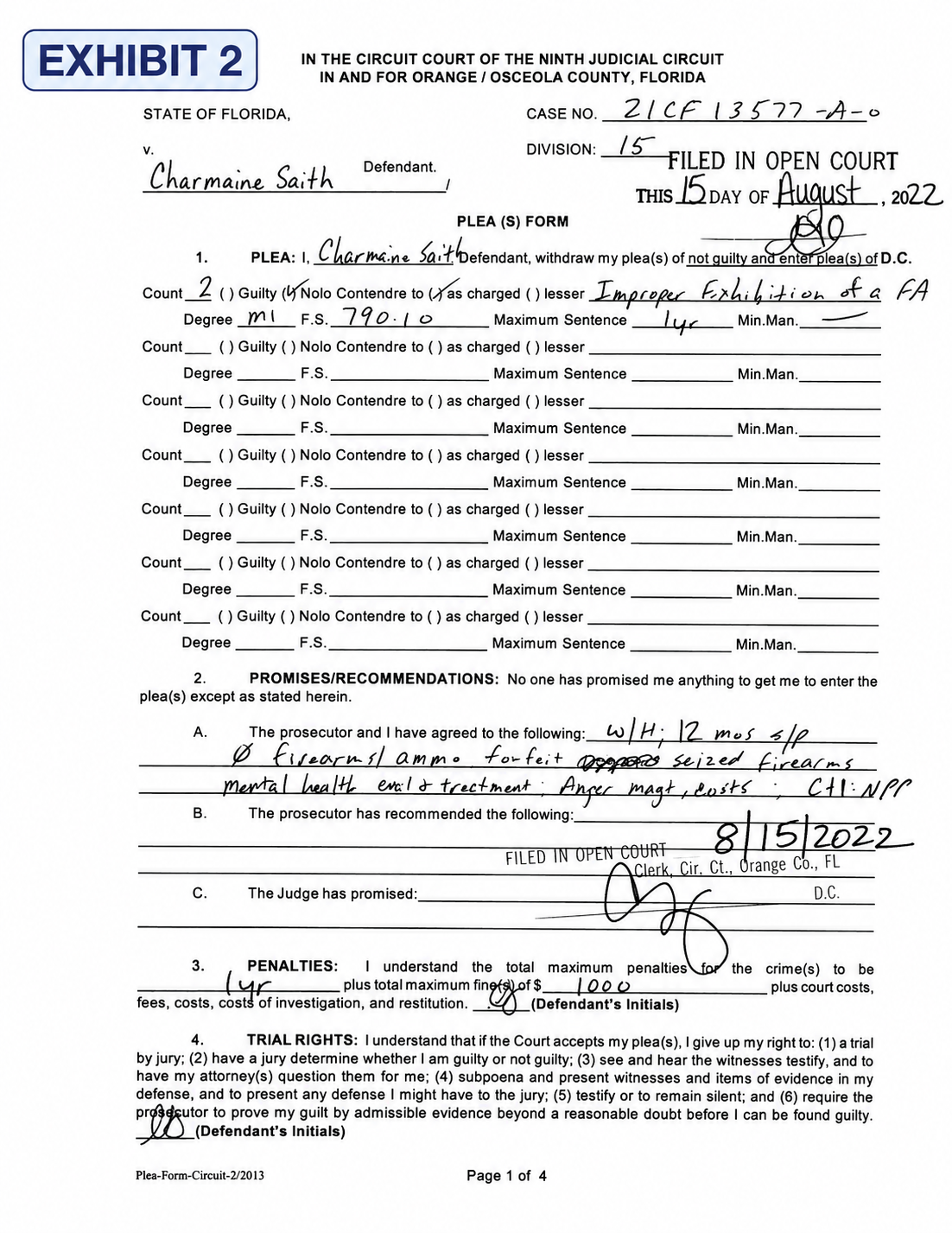
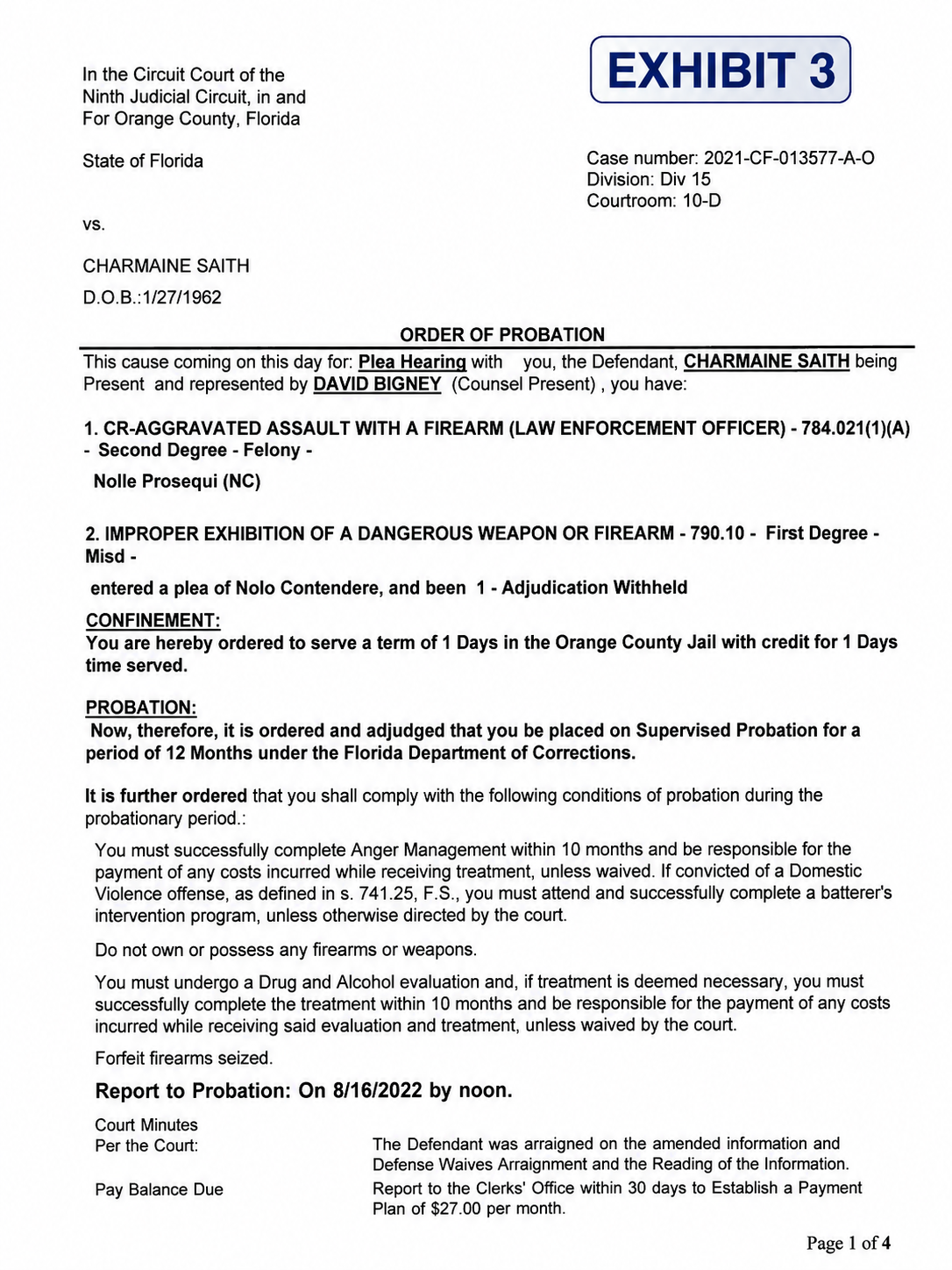
| Element | Handwritten text | Plain English |
|---|---|---|
| Adjudication | W/H | Withhold adjudication |
| Term | 12 mos s/p | 12 months supervised probation |
| Weapons | Ø firearms/ammo | No firearms or ammunition |
| Forfeiture | forfeit [scratched word] seized firearms | Forfeit the seized firearms |
| Treatment #1 | mental health eval & treatment | Mental-health evaluation AND treatment |
| Treatment #2 | Anger mgt | Anger management |
| Money | costs | Court costs |
| Count 1 disposition | Ct 1: NPP | Count 1 (felony aggravated assault) — Nolle Prosequi |
| Term | In oral plea? | In typed Order? | Status |
|---|---|---|---|
| Withhold adjudication | ✓ | ✓ (“Adjudication Withheld”) | match |
| 12 months supervised probation | ✓ | ✓ | match |
| No firearms/ammo | ✓ | ✓ | match |
| Forfeit seized firearms | ✓ | ✓ | match |
| Mental health eval & treatment | ✓ | ✕ — ABSENT | OMITTED |
| Anger management | ✓ | ✓ (“within 10 months”) | match |
| Costs | ✓ | ✓ ($27/month payment plan) | match |
| Count 1 Nolle Prosequi | ✓ | ✓ (“Nolle Prosequi (NC)”) | match |
| Drug & Alcohol evaluation | ✕ — NOT in oral plea | ✓ — PRESENT but optional: “if treatment is deemed necessary… unless waived by the court” | ADDED · OPTIONAL |
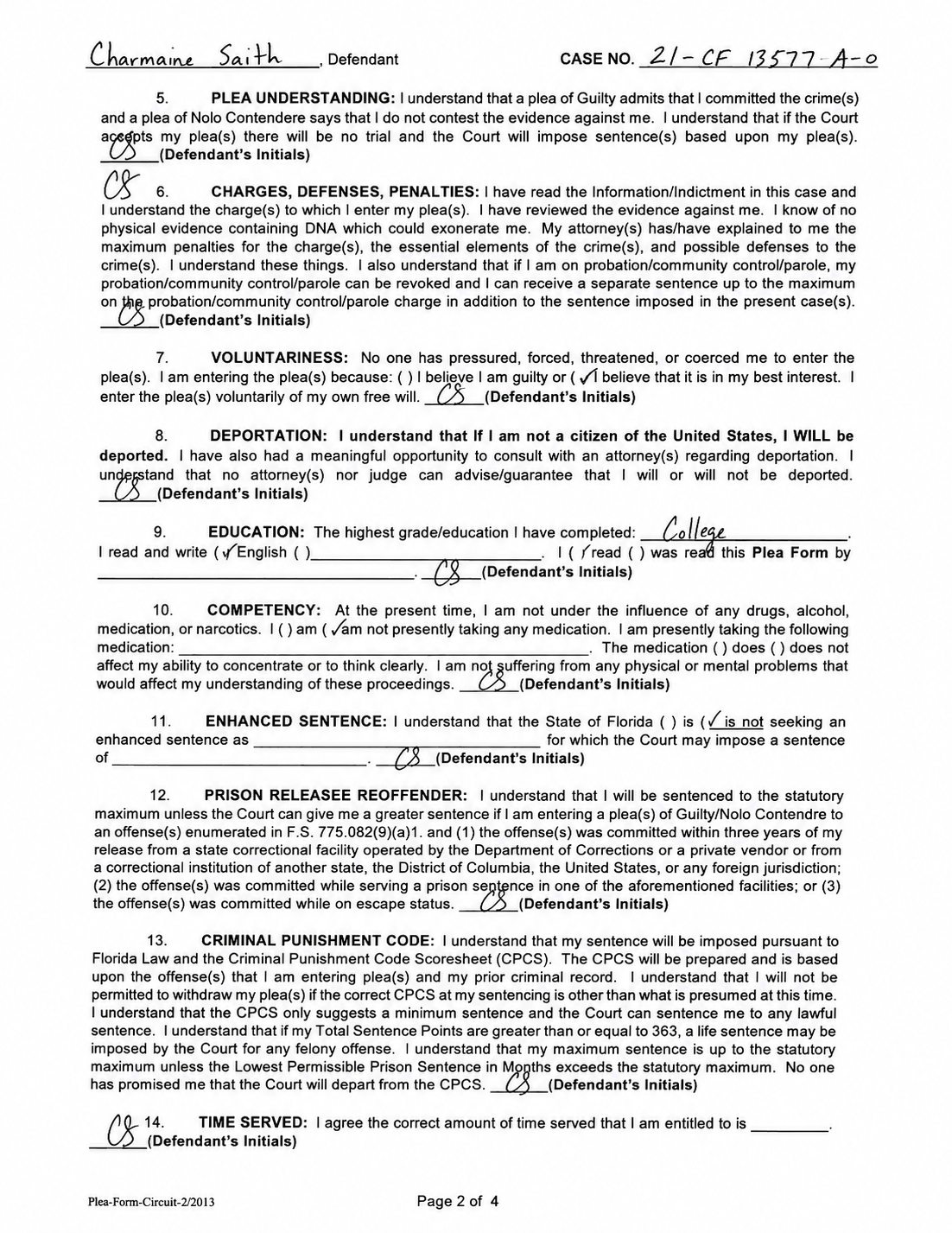
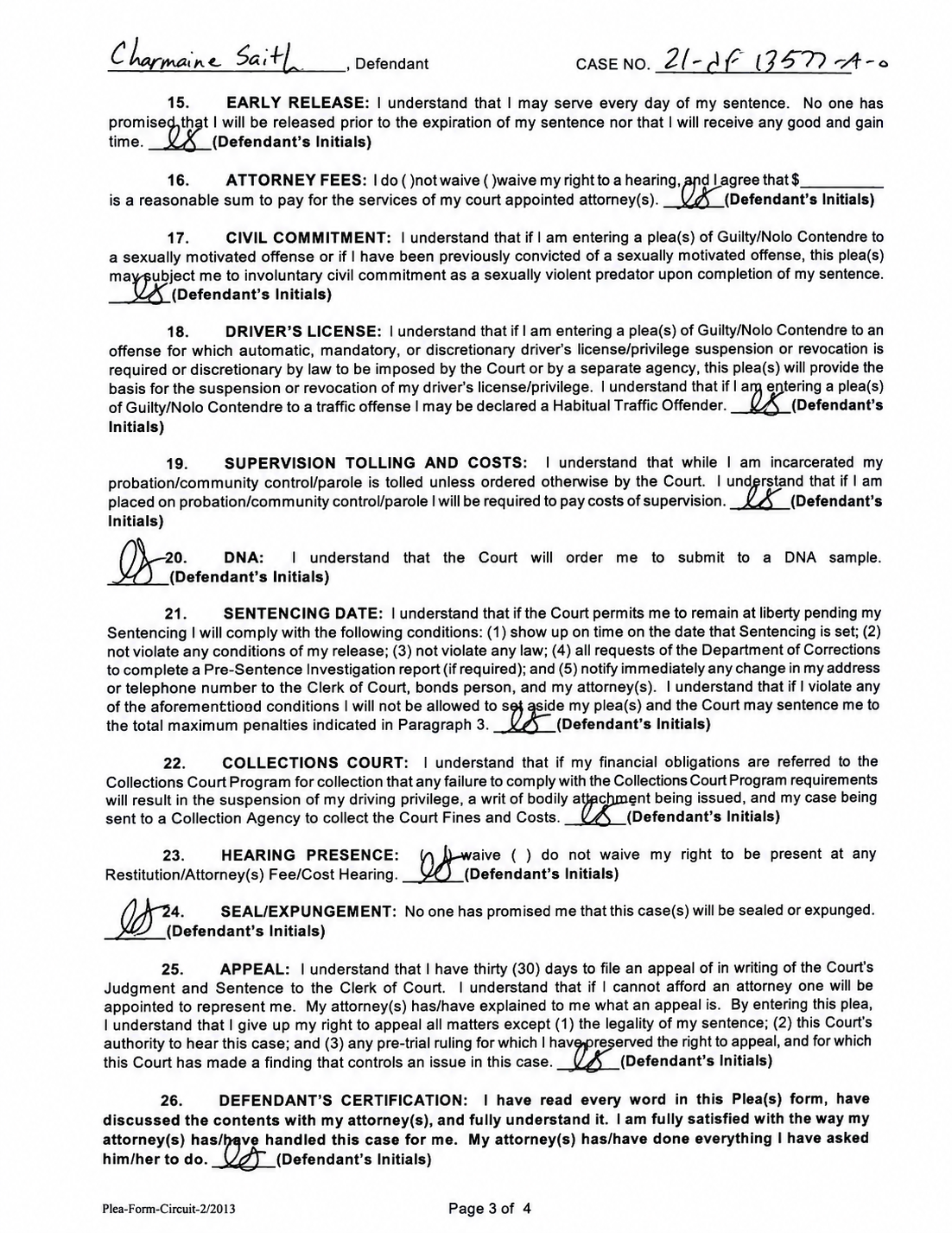
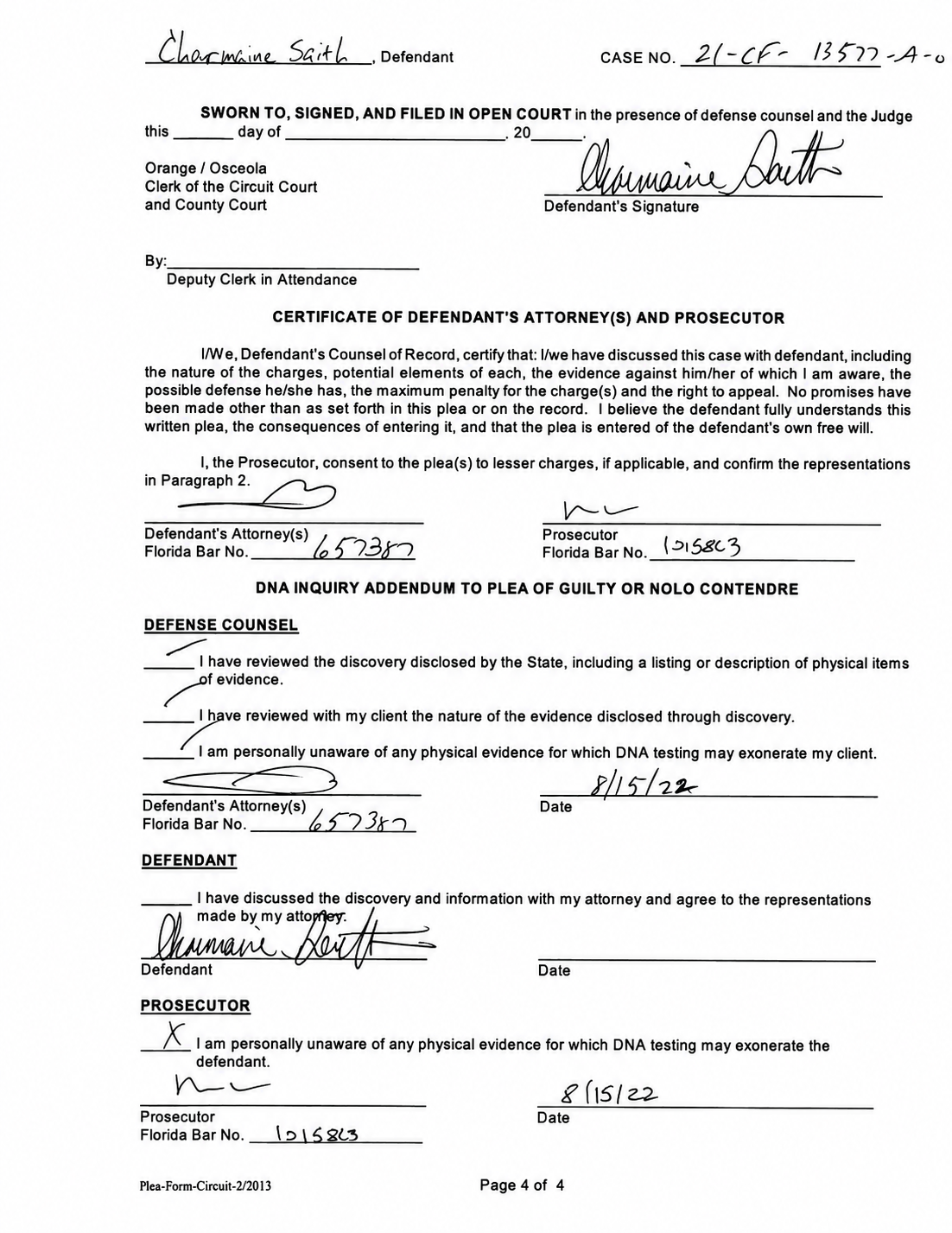
A second integrity note from the signatures themselves: the typed Order of Probation (Exhibit 3) names David Bigney as appearing counsel for the Defendant; the signed Plea (S) Form (Exhibit 2 / page 4) bears the signature and Florida Bar No. of Jason C. Bankowitz as Defense Counsel of record. The same Jason C. Bankowitz later appears as a witness in the related civil dissolution (May 1, 2025 deposition — see Tab 04, Watch Him Work) and is the subject of Florida Bar complaint RFA 25-12168.
The only mark the altered Order carries is therefore an initial of the kind used by the clerk’s office on clerk-generated orders — not a signature personally affixed by Judge Wilson to terms pronounced in open court; defense counsel could not authenticate it as her signature. The consequence: the substitution of a drug-and-alcohol evaluation for the open-court term “mental health eval & treatment” — a term the Judge never pronounced — was given the force of a court order by an initial placed on a document the clerk generated, with no attesting signature from either counsel of record. Who entered the substituted term, and on whose authority Judge Wilson’s initial was applied to it, are the open questions raised — and never answered — in two separate demands: the July 15, 2024 Motion to Request Chain-of-Custody Documentation (before The Hon. Kevin Weiss) and the March 12, 2025 Request for Investigation and Chain-of-Custody Inquiry to the Clerk of Court, copied to the FDLE Public Corruption Unit — the latter expressly asking whether the Judge personally reviewed the order or whether “the signature stamp was applied without proper authorization.” Neither produced disclosure or a response of record.
Why a substitution like this ordinarily goes undetected — and why this case is the exception. Routine sentence reductions issue on clerk-generated orders bearing an applied initial, with no independent check that the typed order matches the plea taken in open court. The structure holds because such a change has no aggrieved party: the defendant benefits from the lighter, waivable condition and never compares the two documents. It is a process an error — or worse — would pass through unnoticed, because in the ordinary case no one looks. This is the rare case in which someone did — the objector is not the defendant but a family member who sought the very mental-health treatment that was removed — and the discrepancy surfaced only because, for once, a person with the opposite interest read the open-court plea against the typed order side by side.
- Williams v. State, 957 So.2d 600, 602 (Fla. 2007) (“It is well established that where there is a discrepancy between the written and oral pronouncements of a sentence, the oral pronouncement prevails.”)
- Justice v. State, 674 So.2d 123, 125 (Fla. 1996) (same)
- Ashley v. State, 850 So.2d 1265 (Fla. 2003) (defendant entitled to enforcement of the plea bargain as orally agreed in open court)
- Fla. R. Crim. P. 3.172 — plea acceptance is an open-court act; the plea form is sworn to, signed, and filed in open court
- Fla. R. Crim. P. 3.800(a) — sentences that do not conform to the open-court pronouncement may be corrected at any time
The Petitioner filed the Motion to Reopen Case Due to Clerical Error and Incomplete Probation Requirements on July 12, 2024 and the Motion to Request Chain of Custody Documentation on July 15, 2024 (both before The Hon. Kevin Weiss, presiding 2024). Neither was ruled upon.
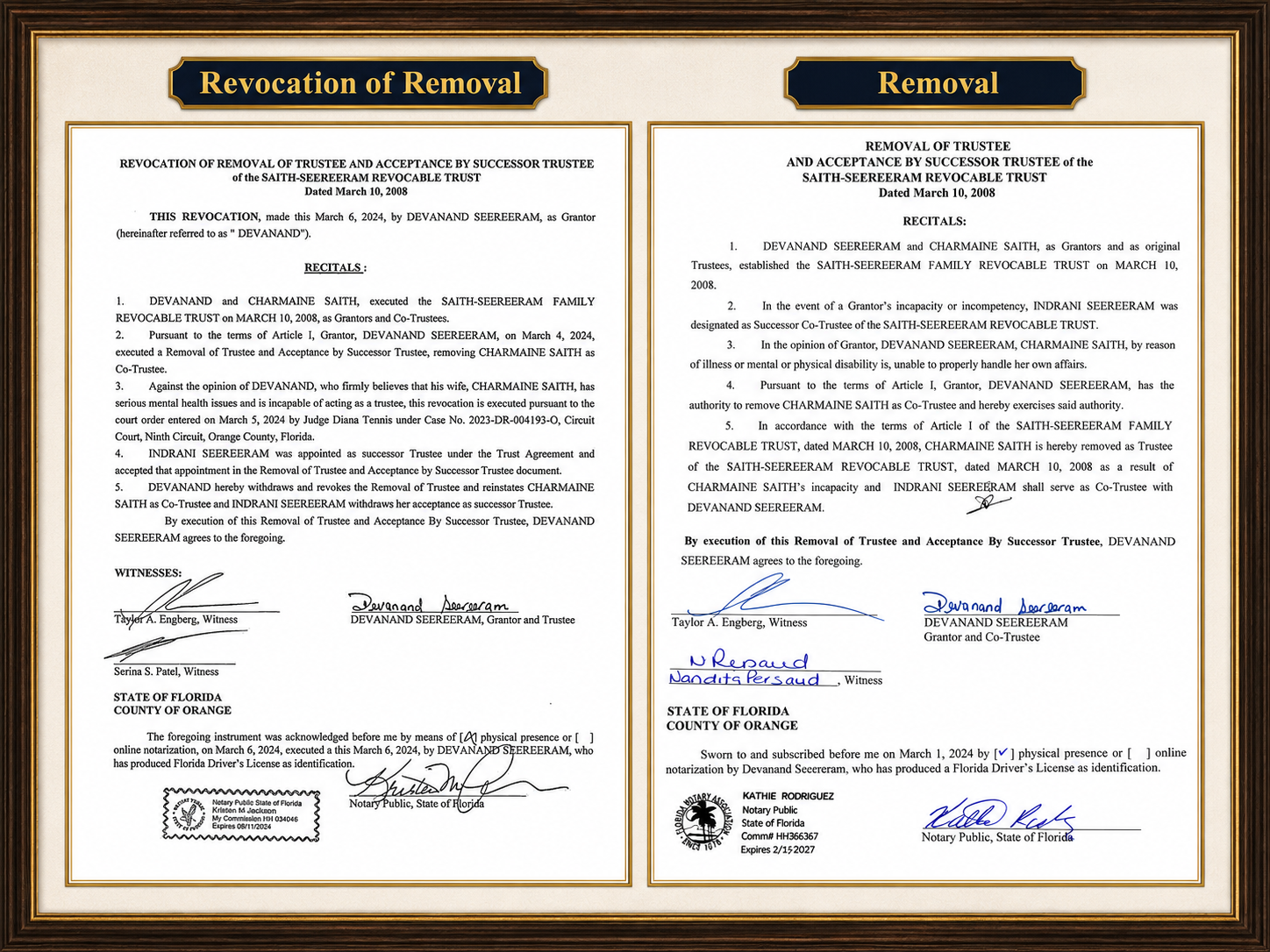
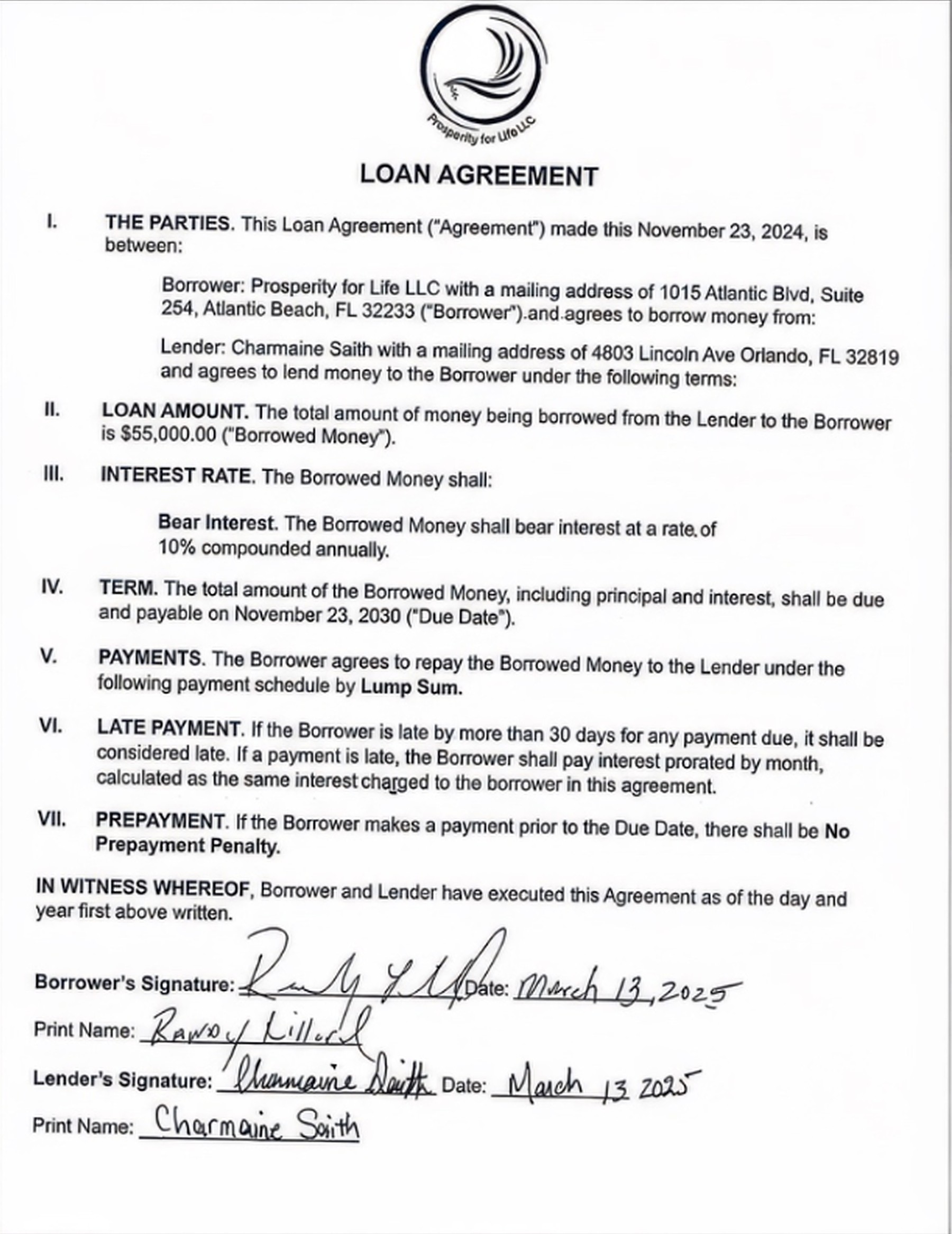
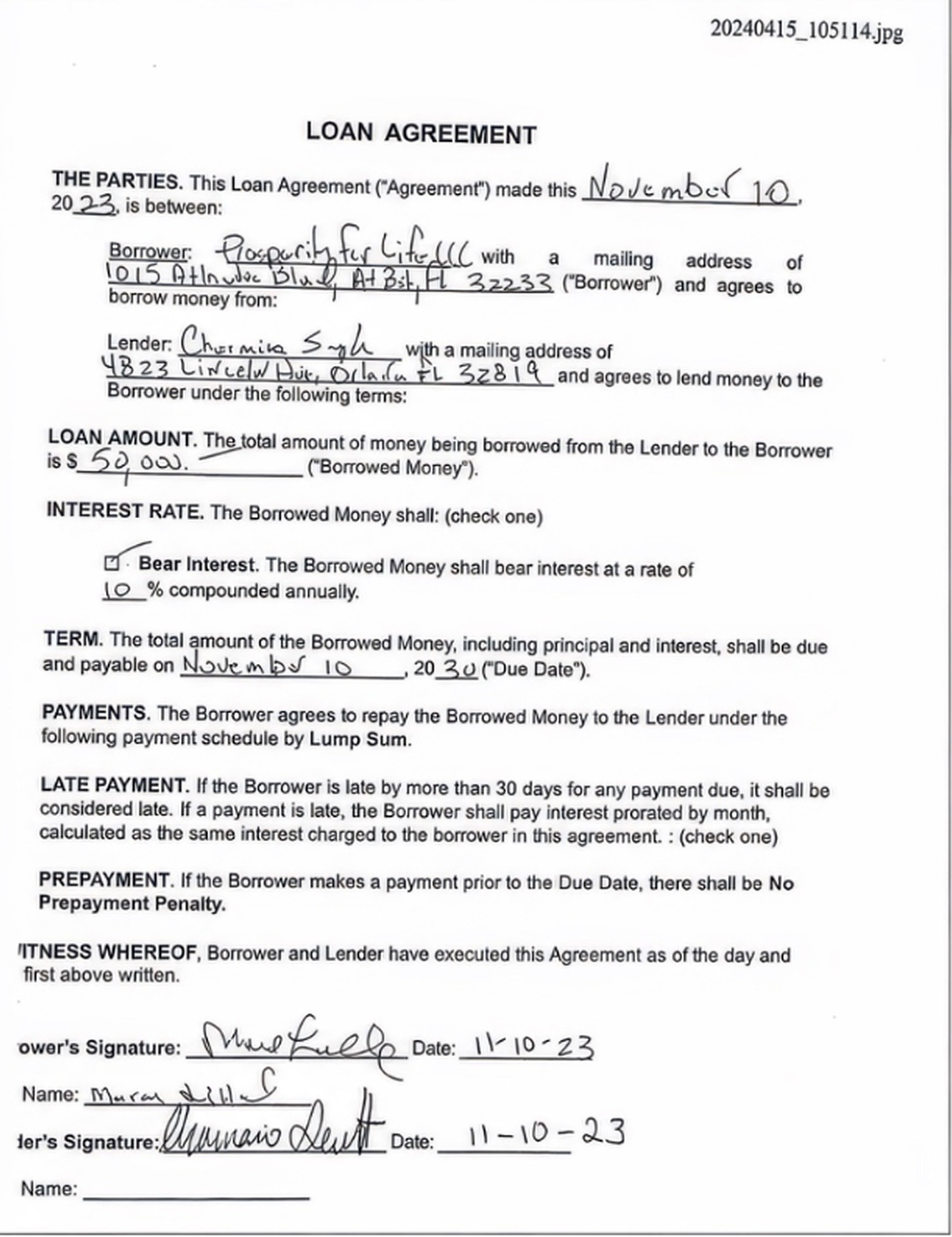
Exhibit — The Manufactured “Loan Agreements”
Two backdated instruments — for a loan to an entity dissolved 54 days before the check — tendered April 29, 2025 to characterize the Nov 15, 2023 transfer of $50,000.
Seereeram v. Saith, Case No. 2023-DR-004193-O — Ninth Judicial Circuit, Orange County, FL
How to read the three dates
| Date written on the document | Right: “Nov 10, 2023” (handwritten) | Left: “Nov 23, 2024” (typed) |
| Date both signatures were signed | Right: 11-10-23 | Left: BOTH signed March 13, 2025 — ~16 months after the transfer, ~110 days after the date the page bears, and one day after Husband told Wife there would be no settlement (trial) |
| First disclosed / filed with Court | April 29, 2025 (both, attached to Wife’s Supplemental Response) | |
| File timestamp on the right scan | Filename 20240415_105114.jpg → digital timestamp Apr 15, 2024, on a page dated Nov 10, 2023 (true creation date reserved for forensic examiner) | |
Field-by-field discrepancies
| Field | First Agreement (11/10/2023) | Second Agreement (11/23/2024) | Why it matters |
|---|---|---|---|
| Loan amount | $50,000 | $55,000 | The $5,000 increase = exactly 10% interest on $50,000 for one year — i.e., interest manufactured on paper, though no payment was ever made. |
| Interest rate | Blank | 10%, compounded annually (written in) | Rate appears only on the later version. |
| Format | Handwritten on a generic template | Typed, with Prosperity for Life logo | Two materially different instruments for one transfer. |
| Lender print-name field | Blank | “Randy Lillard” | Signed for Prosperity by the very person Wife swore under oath (June 27, 2024) she “did not even know.” |
| Lender name / address | Misspelled & incorrect / incomplete | Correct | Identifying details corrected only on the later version. |
| Signature date | 11-10-23 | BOTH signatures dated March 13, 2025 | Second agreement signed ~16 months after the transfer and ~110 days after the date it bears. |
| Term | “Until 2030” | “Until November 23, 2030” | Term made specific only on the later version. |
| Counterparty status | Prosperity for Life LLC administratively dissolved Sept 22, 2023 | Reinstated Aug 7, 2024 (with missing 2023–24 reports) | Both agreements run with a DISSOLVED entity — the dissolution was 54 days BEFORE the Nov 15, 2023 check; reinstatement came only after the Fla. OFR investigation began June 6, 2024. |
Anchors (record, Roen Prima Facie v0.95, Predicates 11 & 37): Mediation collapsed Oct 17, 2023, 13:54 PM EDT. Transfer: $50,000 check to Prosperity for Life LLC, Nov 15, 2023 — 54 days after the entity was administratively dissolved (Sunbiz, Sept 22, 2023). Wife testified June 27, 2024 she did not know Randy Dean Lillard. Both agreements first disclosed/filed Apr 29, 2025 (Wife’s Supplemental Response). Second agreement signed Mar 13, 2025 — one day after settlement breakdown (¶ P37.16). Counterparty under Fla. Office of Financial Regulation inquiry (OFR #122961, opened June 6, 2024); Husband’s Bench Memorandum (Filing #222513407, May 6, 2025) ¶ 3.
Color key:factual discrepancylegal note
The Trust OverreachHe blocked a protective trust clause that has nothing to do with money — before he had read the report he swore existed
The Saith-Seereeram Family Revocable Trust was settled on March 10, 2008 — fifteen years before this divorce. Its very first article, Article I, is a private family safeguard: if one spouse can no longer handle their own affairs, the other may seat a trusted relative as a co-trustee check. It moves no money. It transfers no property. It strips no one of liberty. Mr. Roen moved to block that safeguard — and the record shows he did so months before he had reviewed the mental-health evaluation he had already sworn to a court was complete and favorable.
(it is a trustee-succession safeguard, not a distribution)
(only "the opinion of the other Grantor")
Pillar 1 — Article I is protection, not property
Article I — the first operative article of the 2008 Trust — provides, verbatim:
"If either Grantor dies or is adjudicated to be incompetent or in the event that such Grantor is not adjudicated incompetent, but by reason of illness or mental or physical disability is, in the opinion of the other Grantor unable to properly handle his or her own affairs, then and in that event Indrani Seereeram shall serve with the other Grantor as Co-Trustees hereunder."
Read it for what it is. The trigger at stage one is "the opinion of the other Grantor" — no court adjudication, no physician's certificate, no incapacity hearing. The consequence is equally modest: a sister, Indrani Seereeram, is seated with the other Grantor as a co-trustee. Because co-trustees must act unanimously, Indrani is a built-in check — not a path to control, and not a path to anyone's money. Article I changes who watches the assets, never who gets them. Separate property keeps its character under Article II — it “shall retain its character as separate property of the Grantor who transferred” it, subject to the trust’s own terms — so a change of trustee under Article I does not alter who owns it.
Pillar 2 — Roen moved to block it
On March 4, 2024, Mr. Roen filed a Verified Motion to Enjoin (Filing #193220536) seeking to freeze the Petitioner's invocation of this Article I safeguard. To do it, he demanded the very thing Article I was written to make unnecessary — a prior formal adjudication of incapacity — recasting a private, court-free family mechanism as something that required the court's permission. The Petitioner had simply exercised the power the instrument plainly grants: on March 1, 2024 he seated Indrani Seereeram as successor Co-Trustee on his own opinion of his wife's condition. Mr. Roen's motion existed to stop a safeguard, not to protect an estate.
Pillar 3 — He blocked it before he had read the report
The same March 4, 2024 Verified Motion vouched, under oath, that a recent, satisfactory mental evaluation of his client existed and was in counsel's hands. It was not. Mr. Roen's own sworn fee timesheet (Filing #230534891; retyped at Doc. 0279) contains no entry reviewing any psychological analysis before July 30, 2024 — the first such line is dated July 30, 2024, "Review psych analysis," 0.30 hours, roughly four months later. He bills in tenths of an hour and did bill the review when it finally happened — so the absence of any earlier entry is his own record's admission: he swore to the favorable results of a report he would not read for another four months, and on that footing moved to block a protective clause that turns on no report at all.
And the “evaluation” never materialized as a current report. The only document Mr. Roen ever produced as the promised “mental evaluation” — tendered July 21, 2025, and only after a court order (July 11, 2025) compelled it — was a pair of letters by Dr. Jeffrey Danziger dated February 13 and August 5, 2022: criminal-defense evaluation letters written for Mrs. Saith’s defense attorney, the first before charges were even filed. They were not a recent psychiatric evaluation, and their “no treatment” conclusion was the very opinion the State Attorney rejected — ten days after the August 5 addendum, the August 15, 2022 plea imposed twelve months of mandatory mental-health treatment. So the “satisfactory” evaluation Mr. Roen swore was in hand in March 2024 did not exist — and what he produced in its place was a 2022 pre-plea defense letter, not the current evaluation he had represented.
The documented sequence
- Mar 1, 2024 — Petitioner invokes Article I, seating Indrani Seereeram as successor Co-Trustee (no court, no physician required at stage one).
- Mar 4, 2024 — Roen files the Verified Motion to Enjoin (#193220536), blocking the safeguard and swearing a "satisfactory" mental evaluation already existed.
- Mar 5, 2024 — Judge Diana Tennis enters an order.
- Mar 6, 2024 — Petitioner executes a Revocation, reciting on its face that it was done "against the opinion of Devanand… pursuant to the court order." The objection is preserved in the instrument; the reinstatement was compelled.
- Jul 30, 2024 — Roen's first timesheet entry reviewing any psych report appears — ~4 months after he swore one existed.
The instrument itself — scenario review
Below is the full Trust, article by article, with a side-by-side reading of what happens if the Article I safeguard stands versus if the court blocks it. Note throughout that Article I never reaches the husband's separate property — the dispute Mr. Roen manufactured was never about who gets the money.
Open the full trust analysis in its own tab ↗
Exhibit — the Article I removal and its court-compelled revocation
Sources: Saith-Seereeram Family Revocable Trust (settled Mar. 10, 2008), Article I and Articles II, IV–V. Roen's Verified Motion to Enjoin, Filing #193220536 (Mar. 4, 2024). Roen's sworn fee timesheet, Filing #230534891; retyped at Doc. 0279 (first psych-review entry Jul. 30, 2024). Order, Hon. Diana Tennis (Mar. 5, 2024). Revocation of Removal of Trustee (Mar. 6, 2024). All filings sourced to the Florida e-filing portal, Case No. 2023-DR-004193-O.
Courts and bar rules use a ladder of terms for dishonesty — from an honest mistake up to corrupting the court itself. The deeper the color, the more serious. This tab is about lack of candor — the mildest rung of dishonesty — though several entries in the list below climb much higher.
A lawyer’s duty of candor to the tribunal (Fla. Bar Rule 4-3.3) forbids false statements of fact or law to a court, and requires correcting them. Mr. Roen has stated that duty himself, on the record:
Measured against his own standard, the record holds 0 distinct candor problems below, each stated as He represented versus The record, ranked by how directly his own sworn motion, timesheet, or deposition supplies the contradiction. Each maps to a Predicate in the Full Prima Facie (Tab 03). Contentions from the record, not adjudicated findings.
Tags: ● tagged “candor” the filing itself uses the word / cites Rule 4-3.3 | ○ untagged a candor-type falsehood not labeled as such | ⚠ verify verbatim exact words still to be pulled from the cited transcript before this line goes public.
Sources: the Prima Facie (Tab 03, 41 predicates); Mr. Roen’s sworn Affidavit of Attorney Fees / timesheet (#230534891); his deposition and hearing transcripts; and the filed Notices of Attorney Lack of Candor (Docs 0279, 0284, 0286, 0292, 0299). Items marked ⚠ are awaiting verbatim confirmation from the cited transcript and should be verified before publication. Facial date inconsistencies are stated as documented fact; native-file metadata and signature authentication are reserved for a forensic examiner.
Principal & Agent · The Closed SystemBeyond Prima Facie
The other tabs build a prima facie case — a first showing of misconduct. This tab asks a harder question, and it is the Petitioner’s central legal theory. Tab 12 names the instrument; Tab 13 names its legal consequence. On January 22, 2024, Mr. Roen had Mrs. Saith execute a replacement retainer containing Article III: “the ultimate determination shall be solely and independently that of the Attorney,” and the client and attorney “shall not be considered equal voices or participants.” In the same instrument, counsel’s hourly rate rose from $375 to $450. From that date forward Mr. Roen stopped being a messenger and became a principal whose agent’s acts he owns. Every substantive act after January 22, 2024 is either authorized by the contract he wrote — in which case he owns it under principal-and-agent law — or it is unauthorized, in which case it is a nullity. There is no third box.
This tab sets out the Petitioner’s legal theory — argument and contention drawn from the documentary record. It is not adjudicated findings, and it is not legal advice.
Contact-time figure is drawn from Mr. Roen’s own sworn timesheet (Affidavit of Attorney Fees, Filing #230534891) and is corroborated by Mrs. Saith’s carrier phone-and-text records. See the contact-time analysis in the case file.
If the act was within the “sole and independent” authority he wrote for himself, then as a matter of principal-and-agent law he is responsible for it. He owns it.
If the act was outside that authority, then under Nehleber v. Anzalone (345 So. 2d 822) a lawyer has no implied or apparent authority over a client’s substantive rights — unauthorized acts are a nullity — and under Bursten v. Green (172 So. 2d 472) any such authority must be “clear and unequivocal.” The burden of showing it lies on the party enforcing the agreement. Sharick v. Se. Univ., 891 So. 2d 562 (Fla. 3d DCA 2004).
Box A′ · The phantom third box — “Article III governs and it shields me.”
It forecloses itself. A retainer provision that conflicts with Rule 4-1.2(a) is void as against public policy. Chandris, S.A. v. Yanakakis, 668 So. 2d 180 (Fla. 1995). Article III therefore cannot be enforced for the attorney’s protection — only against him, as the attribution of his agent’s acts to himself. “Embrace and shield” is not a box that exists.
| The post-contract act | Box A — if authorized by Article III | Box B — if he disowns it |
|---|---|---|
| The “Prosperity for Life” loan documents (Nov 2023 / Nov 2024 versions) | Tendered to recharacterize a $50,000 marital transfer — within the agency he assumed. | Unauthorized act on the client’s substantive rights → nullity under Nehleber/Bursten. |
| The financial affidavit / tax-return positions | Substantive declarations of fact made while he was the “ultimate determination.” | A financial affidavit is not “strategy”; if not his to direct, it cannot bind — nullity. |
| The Old Glory Bank transfers (gold → crypto) | Asset movements in the matter he controlled and billed under. | If outside his authority, he cannot have superintended them — yet he billed the period. |
| The $1.4M gold account — first surfacing in the June 2024 deposition | Surfaced at his table, as counsel of record, under Article III. | A lawyer cannot disclaim an asset that materialized in his own deposition. |
| The ~$800K gold depletion after the March 31, 2025 written notice | Continued representation + billing after written notice of the scheme. | Post-notice acceleration is the crime-fraud predicate (below), not a defense. |
That “tax-return positions” row above isn’t hypothetical — here’s the real one, and the timing is the whole thing. Article III made Mr. Roen the “ultimate determination” on January 22, 2024. Nine months later, on October 23, 2024, Mrs. Saith’s 2021 tax return got filed — on the Petitioner’s account, at Mr. Roen’s direction — and it was a fake. That’s not leftover history from before the contract. It’s a brand-new act filed inside the window where, by his own clause, he was running the show.
Return he had her file (Oct 23, 2024): tax she actually paid — $13,316
Her actual 2021 income: ~$923,000
The sworn number and the filed number aren’t even in the same ballpark — and both are fiction, because the real income was close to a million dollars. A $13,316 tax bill on ~$923K of income doesn’t happen by accident. You have to build it.
And building it is exactly what the return did. The Petitioner spelled out all five fabrications in writing and put them in the court record — Filing #226901217 (the “Batch 3” correspondence compilation, E-filed July 9, 2025), at pp. 127–129. Roen never answered it:
The five made-up items — $762,056 worth
• The “Hurricane Sally” dodge — $100,000. A $100K retirement withdrawal got claimed as a federal disaster distribution (Form 8915-F, FEMA DR-4564-FL) to skip the 10% penalty and spread the tax over three years. Catch: she lives in Orlando. Sally never hit Orlando. There was no disaster.
• The hidden retirement cash-outs — $142,564.31. She pulled about $242,564 out of retirement accounts and only reported $100,000 of it (that same fake disaster distribution) — leaving $142,564 unreported. The trick: $277,531 of IRA money got stamped a tax-free “rollover” when it was really cashed out and spent.
• The kids’ college money — $506,963. Half a million pulled from the children’s 529 funds, reported like it barely counted — for “kids” who are 24 and 30 and not in school.
• A $500 “dependent” credit for those same grown children.
• $12,029 in medical bills she never had.
Now put it back in the two boxes. This return is a post–Article III act, so it lands in Box A or Box B like everything else: if the contract gave him the call, he owns the fraud; if it didn’t, the whole position is a nullity. And “I didn’t know” doesn’t fly — his own timesheet bills a “letter to client” on October 22, 2024, the day before the return was filed, with the subject blacked out. That’s the difference this whole tab is about: a taxpayer cheating on her own is one thing — tax fraud run through a lawyer who wrote himself into the driver’s seat is another.
Petitioner’s contention from the documentary record — the 2021 return, the Sept 8, 2023 affidavit, Mr. Roen’s timesheet, and the court-filed correspondence (Filing #226901217) — not adjudicated findings. The affidavit listed the $100K as a possible/contingent IRS liability (labeled “2020”); the fraudulent filed return is tax-year 2021. “At Mr. Roen’s direction” rests on the timing and the redacted Oct 22 letter, not an admitted statement.
1. “I was just following my client’s instructions.”
He drafted Article III to negate this — it says he is the determination, not a follower. And ~4 hours of contact cannot have produced granular instructions on a $2.5M action, a tax return, and structured transfers.
2. “Article III governs strategy, not substantive decisions.”
The clause says “the running and handling of the client’s legal matter,” not tactics. Rule 4-1.2(a) reserves objectives to the client; Article III inverts that. Affidavits and tax returns are facts, not strategy.
3. “I didn’t know about the underlying fraud.”
The March 31, 2025 written notice put the scheme on his desk; the $1.4M gold surfaced in his own deposition; and a self-appointed “sole” decision-maker carries a heightened duty of inquiry, not a scrivener’s ignorance.
4. “She signed it. She had capacity.”
Capacity was already in question on the record — Windle declined the representation in 2021 on capacity grounds, and the Aug 15, 2022 plea adjudicated a mental-health-evaluation-and-treatment condition. A retainer provision that conflicts with Rule 4-1.2(a) the way Article III does is void as against public policy, regardless of signature. Chandris, S.A. v. Yanakakis, 668 So. 2d 180 (Fla. 1995). And under settled fiduciary principles, a transaction between a fiduciary and the person owed the duty — executed mid-representation, in the same instrument that raised the fiduciary’s own rate — is presumptively voidable, with the burden of fairness on the fiduciary. Signature triggers the scrutiny; it does not cure the conflict.
5. “Privilege blocks inquiry into all this.”
The crime-fraud exception, §90.502(4)(a), removes the privilege on a prima facie showing the client used the lawyer’s services in furtherance of a crime or fraud — the showing this record makes. (See box below.)
6. “I’ll withdraw and clean my hands.”
Withdrawal is not a time machine: it does not unmake the billing, the Article III period, the filings, or the fee request. And Rule 4-1.16(a) withdrawal is mandatory when continued representation would violate the Rules — so timing the exit now is itself an admission the trigger has fired. It does not escape the predicate; it confirms it.
7. “An independent expert says my fees are reasonable.”
The Petitioner contends the fee expert — Damon Weiss, Esq. — is not arm’s-length: a documented prior Roen–Weiss fund-transfer relationship of record (Broadbent, Filing #195813353) and a contemporaneous motion to disqualify the Weiss firm (Filing #192458931). Without independent reasonableness testimony, the $100,015 fee request is tested against Rosen v. Rosen, 696 So. 2d 697 (Fla. 1997), and §61.16, Fla. Stat.
8. “The husband is vexatious; this is retaliation.”
A party who rested on the record (Conditional Waiver, July 9, 2025) and appears defensively since the Aug 2024 withdrawal does not fit the Rosen “harass / frustrate / delay” factor. The label dies on the docket.
9. “Even if Article III is shaky, she ratified the acts by continuing.”
Ratification requires full knowledge of the material facts — the general Florida rule, stated in Frankenmuth Mut. Ins. Co. v. Magaha, 769 So. 2d 1012 (Fla. 2000) (a public-contract case, cited only for that principle). The concealed-liquidation pattern, the backdated loans, the $1.4M gold account first surfacing at the June 27, 2024 deposition, and the March 31, 2025 notice mean the client never had that knowledge — and the capacity overlay (Dodge 4) forecloses it independently.
The exception turns on a prima facie showing that the client used the lawyer’s services in furtherance of a crime or fraud — and the word in the standard is prima facie, which the other tabs already satisfy. The Petitioner’s contention is that the record supplies it: a retainer placing the attorney in “ultimate determination”; written notice on March 31, 2025 of an ongoing scheme to convert traceable marital assets into untraceable cryptocurrency through a non-reporting bank; and continued billing and filings after that notice, including an ~$800K depletion of the gold position.
Consequence: within its scope, the privilege does not shield the knowledge timeline — so Mr. Roen cannot use privilege to seal off what he knew and when. And on June 3, 2026, Mr. Roen invoked blanket attorney-client privilege over non-privileged source-of-funds questions; that invocation was filed of record the next day (Filing #249628116, June 4, 2026). On counsel’s own words, the communications the privilege is meant to shield are the communications the crime-fraud exception is meant to reach.
The same analysis is set out in the Petitioner’s Prima Facie at § 26.12 (the Principal/Agent Umbrella) and the § V-E 35-row attribution map.
Sources & authorities: Jan 22, 2024 Contract for Legal Services, Art. III (verbatim); Fla. Bar Rules 4-1.2(a),(d) & 4-1.16; Nehleber v. Anzalone, 345 So. 2d 822 (Fla. 4th DCA 1977); Bursten v. Green, 172 So. 2d 472 (Fla. 2d DCA 1965); Chandris, S.A. v. Yanakakis, 668 So. 2d 180 (Fla. 1995); Doe v. Evans, 814 So. 2d 370 (Fla. 2002) (general fiduciary-duty principle; a clergy case, cited only for that principle); §90.502(4)(a), Fla. Stat. (crime-fraud); Rosen v. Rosen, 696 So. 2d 697 (Fla. 1997) & §61.16, Fla. Stat. (fees). Case citations and the statute text were verified against public legal databases. Everything on this page is the Petitioner’s legal theory and contentions — argument, not adjudicated findings — and is not legal advice.
The Children’s Money — a $506,963 college fund, and five versions of whose money it was
Two college-savings accounts — 529 plans set up for the parties’ two daughters, seeded by the children’s grandfather in 2007 and funded by the Petitioner — were emptied into the mother’s personal checking account in February and March 2021. The figures below are printed on the Truist #4011 bank statements; the quotations are verbatim from the depositions, Mr. Roen’s correspondence, and his filing. The Petitioner’s contention is narrow: the money was the children’s, and Mr. Roen described it differently each time the description mattered.
The grandfather’s seed gift
Check #3873 from the Petitioner’s firm, memo “Ramjass Seereeram gifts to [the two daughters].” Establishes the 529s as the children’s — funded by the grandfather and the Petitioner, not marital cash.
Elder daughter’s 529 — emptied
Truist #4011 statement line: “Electronic/ACH Credit — Vgi 529 ACHDeposit ****6364,” $287,307.17, into the mother’s personal checking.
Younger daughter’s 529 — emptied
Statement line: “Electronic/ACH Credit — Vgi 529 ACHDeposit ****6423,” $219,655.92. The same week, jewelry charges clear from the same account.
“It is the children’s … used for child purposes” — intact
“They’re all hers”
Blocks the question
“Not available to be used by Ms. Saith?”
“The accounts have been closed … subpoena it yourself”
Two $10,000 checks paid Mr. Roen, both drawn on the same SunTrust account ending #4011 — the account that received the children’s 529 deposits, titled jointly in the elder daughter’s name.
Check #3688 — $10,000 to Hal Roen
Drawn on SunTrust account ending #4011. This payment predates Mr. Roen’s June 7 2023 concession — included for completeness, not for the knowledge point.
Check #3812 — $10,000 to Hal Roen, memo “retainer”
Same #4011 account; endorsed “For Deposit only … HAL ROEN PA.” This payment lands eight months after Mr. Roen called the funds “the children’s” (June 7 2023) and three weeks after the Jan 12 2024 civil complaint that detailed the 529 conversion.
Sources: Truist #4011 account statements (Exhibits 1–2, May 8 2025 Crime-Fraud-Exception Hearing); canceled checks #3688 (Aug 30 2022) and #3812 (Feb 5 2024) payable to Hal Roen, drawn on SunTrust #4011; grandfather’s check #3873 dated Dec 10 2007 (Exhibit 15); Charmaine Saith Depositions (Apr 1 2024; Jun 27 2024); Devanand Seereeram Deposition (Jun 27 2024); Hal Roen settlement correspondence (June 7 2023); Wife’s Response to Notice to Produce (Filing #217445521, Feb 24 2025). Legal framework: Fla. Stat. §§ 812.019, 896.101, 90.502(4)(a), 90.803(18); Fla. Bar Rules 4-1.2(d), 4-1.15, 4-8.4, 5-1.1; Caplin & Drysdale v. United States, 491 U.S. 617 (1989); Wiand v. Lee, 753 F.3d 1194 (11th Cir. 2014). All quotations are verbatim from the record; check numbers, account numbers, and dates are printed on the instruments and statements. Everything on this page is the Petitioner’s contention drawn from the documentary record — not adjudicated findings — and is not legal advice. The children are not named.
The $1.4 Million Omission — the affidavit Hal Roen drafted, and what it left out
On September 8, 2023, Mrs. Saith filed her sworn Family Law Financial Affidavit (Long Form) over Mr. Roen’s certificate of service. His own billing shows he built it personally across three work sessions that August (08/07, 08/17, 08/31). The document swore to $0 monthly income, listed the joint Truist #4011 checking at just $4,703, and marked $0 in liabilities. On the same day it was signed, the Petitioner’s forensic reconstruction from her own bank records shows she held, off the affidavit, on the order of $1.4 million in gold plus more than $1.3 million in other moved funds.
The gold account (APMEX #2225707) appears on no affidavit. It did not have to. APMEX bills a small quarterly storage fee — about 0.12% of the metal it holds — and that fee posts as a line item on Mrs. Saith’s own Truist #4011 statements. The holdings reverse-solve directly from the fee:
The purchase side confirms the same scale, independently: $1,120,777 into APMEX gold Feb–Nov 2021 (about 614 oz), $717,000 in a single month (Nov 2021), total purchases over $1.4 million through Jan 2022, plus more than $90,000 in gold jewelry. Two independent methods — the storage-fee back-solve and the purchase tally — land on the same figure the deposition later confirmed to the penny: $1,411,644.82.
| Vanguard + Fidelity moved out and converted to gold | $1,338,963.09 |
| Cash withdrawn from communal funds | $107,925.00 |
| Debit-card spending on personal use (jewelry, dance, clothing) | $29,231.09 |
| IRS refund retained | $25,000.00 |
| Residence / household expenses charged to communal funds | $118,498.65 |
| Total documented claim | ≈ $1,821,274.52 |
Liquid gold cash-outs around the signing — still left off
Two gold liquidations to cash cleared just before the affidavit was sworn: Aug 1, 2023, ≈$19,400 and Sep 12, 2023, ≈$19,200 — four days after the affidavit. Cash proceeds in hand at signing, not listed. The clearest single indication, the Petitioner contends, that the omission was not an oversight.
The gold was what the affidavit left out. Here’s what it put in. On the very same sworn form (page 11), under “possible liabilities,” Mr. Roen’s affidavit carried one tax entry — “IRS 2020 — $100,000” — and marked $0 in actual liabilities. That was the entire tax disclosure. No mention that Mrs. Saith had stopped filing returns, and no hint that roughly $923,000 of 2021 income was sitting unreported.
This is why it sits in crime-fraud territory, not “sloppy paperwork.” The same lawyer touched both ends of the tax thread: he drafted the affidavit that shrank a felony-scale tax fraud into a $100K footnote (Aug 2023), and a year later the fraudulent 2021 return was filed on his watch (Oct 2024). The full breakdown of that return — the phantom “Hurricane Sally” disaster claim and the rest, $762,056 of it, now in the court record at Filing #226901217 — is laid out in Tab 13 (Beyond Prima Facie).
The $100,000 was listed as a possible/contingent liability, labeled “2020”; the fraudulent filed return is tax-year 2021. “Under Mr. Roen’s direction” is the Petitioner’s contention from the timing and a redacted Oct 22, 2024 client-letter entry on Mr. Roen’s own timesheet — not an admitted statement.
Discovered the night before mediation
Reading the APMEX storage-fee lines on her own statements, the Petitioner identified the concealed gold the night before the Oct 17, 2023 mediation and presented the first evidence of dissipation there. Mediation reached total impasse.
Surfaced at deposition — “all marital”
The affidavit was never amended
No amended Long-Form affidavit adding the gold was ever filed after the omission was known. Under Florida’s continuing duty to supplement mandatory financial disclosure, the Petitioner contends the September 2023 affidavit was not a one-time event but a sworn filing left false and uncorrected through the period Mr. Roen pursued fees, contempt, and incarceration.
Sources: Mrs. Saith’s Family Law Financial Affidavit (Long Form), filed Sept 8 2023 (Filing #181387486), over Mr. Roen’s certificate of service; Mr. Roen’s billing entries of Aug 7, 17, 31 2023; Truist #4011 account statements and the APMEX storage-fee lines (annotated in the Petitioner’s Financial Claim Against Charmaine Saith, Vols. 1–2; pattern analysis Vol. 4); APMEX Account #2225707 statement marked Petitioner’s Exhibit 2 (June 27 2024 deposition); Charmaine Saith Deposition (June 27 2024, Tr. 47–48). The 0.12% / ÷0.0012 storage-fee method is the Petitioner’s forensic reconstruction, to be corroborated against the APMEX fee schedule of record. All dollar figures are the Petitioner’s computation from produced records; the $1,411,644.82 deposition figure is read verbatim from Exhibit 2. Everything on this page is the Petitioner’s contention drawn from the documentary record — not adjudicated findings — and is not legal advice. The children are not named.
179 Days in Jail — how “I’m not seeking sanctions” became a demand for 179 days behind bars
On June 23, 2026, Mr. Roen asked the Court to jail Devo for 179 days. Six months earlier, on the record, he said he was not seeking sanctions for Devo’s absence — because it made the hearings go faster. Between those two dates, the demand escalated from nothing to one day short of six months — against a man who had already withdrawn his petition, waived his appearance, and filed a certificate of compliance with the very order the jail request is built on.
The contempt cycle did not begin with any misconduct by Devo. It began five days after he filed a motion for summary judgment that would take the Trust out of the marriage entirely — and with it, the premise of Mr. Roen’s three years of litigation.
Devo — Motion for Summary Judgment: the Saith-Seereeram Family Revocable Trust is non-marital #234370168
A dispositive motion that, if granted, removes the Trust from the marital estate altogether — and with it the premise of the injunction. This is the filing that changes the stakes: if the Trust is non-marital, three years of litigation against it collapses.
Wife / Roen — Motion for Contempt #234677231
Five days after the MSJ, the first contempt motion arrives — asserting Devo failed to produce financial documents. (His own sworn timesheet had already billed for reviewing documents “provided by husband on 2nd flash drive” — see the Lack of Candor tab.)
Court reserves; Roen expressly declines sanctions
The Court ordered production (bank statements 7/1/23–10/2025) and reserved on any sanction. As of that hearing, counsel was on record wanting no sanction and treating Devo’s non-appearance as a convenience.
The number is not arbitrary. Criminal contempt is a crime like any other: when the punishment runs more than six months the accused has a constitutional right to a jury trial; at six months or less the charge is “petty” and a single judge decides it alone. Bloom v. Illinois, 391 U.S. 194, 201–02 (1968); accord Aaron v. State, 284 So. 2d 673 (Fla. 1973). 179 days is one day under that line — the most jail a court can impose for criminal contempt without ever empaneling a jury.
The “or until the terms of a purge can be complied with” clause does not open the jury door — it bolts it from the other side. A sanction a person can end by complying is civil coercive contempt, and civil contempt carries no jury right at any length, because the contemnor is said to “hold the keys to the jail.” Int’l Union, UMWA v. Bagwell, 512 U.S. 821, 827–29 (1994). So read as civil, the request reaches no jury because civil contempt never does; read as criminal — a fixed 179-day term — it reaches no jury because 179 is under the six-month line. Drafted as both at once, it forecloses a jury under either characterization.
Capped and conditioned that way, the matter never reaches a jury. None is empaneled — so none is shown the sworn timesheet, the financial data, or the de-facto guardianship. It is the most incarceration that can be demanded while keeping that door shut.
Nor is this obscure law to the lawyer who wrote the motion. Contempt is the family-law bar’s everyday enforcement tool, and the six-month cap is the guardrail it drafts against — the Florida Supreme Court’s own leading example of where the jury line bites is “domestic relation matters.” Aaron v. State, 345 So. 2d 641, 643 (Fla. 1977). A number like 179 — not “six months,” not “180” — is one a fifty-year practitioner arrives at on purpose, by subtracting a single day from the line.
Devo withdrew his Petition #204182415
He is not the one seeking relief from the court.
Devo filed a Notice of Conditional Waiver of Appearance #226936923
His non-attendance is not defiance — it is a waiver of record, the very absence Roen called a convenience on Dec 9, 2025.
Devo complied with the Trust order
He filed a Certificate of Compliance within the order’s five-day window; the Court entered no finding that the Trust’s terms or status were ever altered. The order enjoined altering a trust, not ordinary spending from a personally-titled account.
The escalation follows Devo telling the Court the Trust’s only beneficiaries are the two children
The 179-day motion seeks contempt of the March 5, 2024 injunction over the Saith-Seereeram Family Revocable Trust. Devo placed on the record that the Trust’s only beneficiaries are the parties’ two children — a trust that runs to the children, not to either spouse. The incarceration demand intensified after that point was made.
Two motions would pull the Trust out of the marital estate — no order has been entered on either
Two of Devo’s filings would remove the Trust from the divorce entirely: the Motion to Declare the March 5, 2024 Order Void for Lack of Subject-Matter Jurisdiction (#233817170, Oct 16, 2025) and the Motion for Summary Judgment that the Trust is non-marital (#234370168, Oct 24, 2025). No written order has been entered on either. The void motion sat unruled for 207 days; the summary-judgment motion was orally denied on Feb 9, 2026 — with the Court stating it had not reviewed the motion or the response — yet was never reduced to a signed order, so under Florida law the Trust’s marital / non-marital status remains unresolved. Mr. Roen has litigated the Trust as a marital asset across the roughly four-year dissolution fight, and now seeks 179 days’ jail on that same unresolved foundation.
The motion complains of an account it admits is not the Trust’s
The order enjoined altering the Trust. The motion alleges Devo moved funds in Vanguard #5872 — yet its own ¶4 concedes #5872 is titled solely to “Devanand Seereeram” individually, not to the Trust. The one account the order actually governed (#0112) the motion concedes was down to $1.00 by Dec 31, 2021 — before the petition and before the order existed. A trust-injunction contempt built on a non-Trust account reaches conduct the order does not.
Sources: Wife’s Motion for Contempt (Filing #251014916, June 23 2026); CMC transcript, Dec 9 2025 (Landmark Reporting, Inc.), p. 9; Cross-Notice of Hearing (Filing #235800311, Nov 14 2025, enumerating the Oct 2025 motion sequence); Wife’s Motion for Contempt (#234677231, Oct 29 2025); Retaliatory Contempt Motion (#239652607, Jan 16 2026); Notice of Hearing (#240048085); Wife’s Motion for Issuance of Writ of Bodily Attachment (#240962066); Devo’s Notice of Withdrawal of Petition (#204182415, Aug 7 2024); Notice of Conditional Waiver of Appearance (#226936923, July 9 2025); Order Enjoining Husband … (Filing #193295225, March 5 2024, Judge Tennis) and Certificate of Compliance (March 8 2024). Legal framework: Bloom v. Illinois, 391 U.S. 194 (1968); Int’l Union, UMWA v. Bagwell, 512 U.S. 821 (1994); Aaron v. State, 284 So. 2d 673 (Fla. 1973) and 345 So. 2d 641 (Fla. 1977); Fla. R. Crim. P. 3.840; § 38.22, Fla. Stat. All quotations are verbatim from the cited record; filing numbers and dates are from the Florida Courts E-Filing Portal. Everything on this page is the Petitioner’s contention drawn from the documentary record — not adjudicated findings — and is not legal advice.
Sealing the Record — how evidence of the judge’s own ethics violations was almost hidden, with counsel’s help
Every other tab on this site documents Mr. Roen’s conduct toward his client, the opposing party, or a witness. This one is different in kind. On August 12, 2024, a pro se litigant put primary-source evidence of the presiding judge’s own Canon 7 political-contribution violations into the public court file. Two hours and forty-five minutes later, Wife’s counsel moved to seal it — “for the protection of the judicial branch.” The next morning, in chambers and without a hearing, the judge “reserved” that sealing motion for trial in the very same order that refused to step aside — a disposition that, by rule, made the record presumptively confidential without any finding at all. Nearly two years later, the Florida Supreme Court answered the question of how serious that buried record was.
Counsel moved to seal the litigant’s FEC-sourced Canon 7 evidence; the presiding judge — whose own contributions were the subject — reserved the seal for trial and denied recusal in one two-line order.
The Florida Supreme Court rejected the agreed public reprimand as too lenient, holding it “would impose a suspension and fine” on Judge Tennis for that same contribution conduct.
Devo files his Final Motion to Recuse Judge Tennis — Canon 7 violations #204482114 [open the original PDF]
The motion documents, from primary-source FEC data, 913 political contributions totaling $29,154.76 (Jan. 26, 2017–Jan. 31, 2021) made in the judge’s own name, occupation listed “JUDGE,” employer “STATE OF FLORIDA” — the largest documented sitting-judge violation of Florida Code of Judicial Conduct Canon 7A(1)(e) in the public record. It was the third recusal motion; the prior two were denied “legally insufficient.”
Roen moves to seal it — 2 hours 45 minutes later #204508525
The motion identifies none of the confidential-record categories Rule 2.420(c) enumerates, no statute, and no compelling interest — only that public criticism of a sitting judge, drawn from public FEC data, should itself be hidden.
Judge Tennis, in chambers, no hearing — one order, two rulings #204590429
In a single instrument the judge (a) refused to step aside from a case now containing evidence of her own violations, and (b) took the one step that shielded that evidence from public view.
The letter is hand-delivered to the Chief Judge
Devo delivered a letter to Chief Judge Lisa T. Munyon setting out the contribution record and attaching a printout together with a step-by-step guide for verifying it on the Federal Election Commission website. 913 contributions totalling $29,154.76 between January 26, 2017 and January 31, 2021 — a span of 1,466 days. That is one political contribution every 1.6 days, for four years, averaging $31.93 each. Not a handful of cheques; a standing arrangement running continuously while she presided.
Judge Tennis grants the disqualification she had denied forty-seven hours earlier — 2 hours 24 minutes after delivery #204794462
Three sentences, over her own signature. No findings, no reasons, no hearing — and nothing had happened in the case since the Aug 13 denial. No new motion, no new filing, no argument. The only intervening event was the letter. Note also the form: this is an amended order. A judge who reconsiders enters a new order and explains why; amending the original replaces the denial rather than reversing it.
The administrative reassignment follows — five minutes and nine seconds later #204795117
An Order of Reassignment for Unified Family Court, signed by the Administrative Judge, moved the case from Div 38 to Div 31 under Fla. Fam. L.R.P. 12.003 and cancelled all hearings previously set. The stated ground is routine consolidation; it mentions neither recusal nor the order entered five minutes before it. The reassignment executed Judge Tennis’s own disqualification order — it did not substitute for one. [open the original PDF]
The “shameless diatribe” line is not the only one. Mr. Roen titled the motion, in his own running footer, “Motion to Protect Judiciary and to Seal” — and the body escalates from there. Each quotation below is verbatim from Filing #204508525.
The record those paragraphs dismiss as “childish and boorish” venting is the same 913-contribution Canon 7 record the Florida Supreme Court would later find warrants a suspension and fine. The motion never engages the data — it asks only that the public not be allowed to see it, and threatens a defamation suit for the attempt.
A motion to seal that is denied leaves the record public. A motion to seal that is “reserved” does something else. Under Fla. R. Jud. Admin. 2.420(d)(1)(B), the clerk may presume that a confidentiality motion not yet ruled upon will be granted, and may treat the record as confidential until further notice. By reserving — rather than denying — a motion that fell outside every category the rule allows, the disposition converted the evidence of the judge’s own Canon 7 conduct into a presumptively confidential record: no order of sealing, no findings, no hearing — the shielding accomplished by the joint operation of counsel’s motion and a two-line order.
The Judicial Qualifications Commission investigated and confirmed the same 913-contribution pattern, and the parties agreed to a public reprimand. On July 2, 2026, the Florida Supreme Court refused to accept it:
The significance is narrow and factual: the record Mr. Roen moved to seal “for the protection of the judicial branch” was not a “shameless diatribe.” It documented conduct the State’s highest court has now found serious enough that a reprimand alone will not do — suspension and a fine are warranted.
The Florida Bar rule most directly implicated is Rule 4-8.4(f): a lawyer “shall not… knowingly assist a judge or judicial officer in conduct that is a violation of applicable rules of judicial conduct or other law.” A sealing motion that requests confidentiality for a judge’s own publicly-documented Canon 7 violations — addressed to that same judge — is, on its operative effect, the conduct that rule describes. The motion also failed to disclose the controlling public-access authorities directly adverse to it — Press-Enterprise II, Richmond Newspapers, Article I § 24 of the Florida Constitution, and Barron v. Florida Freedom Newspapers — implicating Rule 4-3.3(a)(2), and the concealment-of-bias concern engages the impartial-tribunal guarantees of Caperton v. A.T. Massey Coal Co. and In re Murchison.
Sources: Devo’s Final Motion for Reconsideration of Recusal (Filing #204482114, Aug 12 2024) — PDF; Roen’s Motion to Seal (Filing #204508525, Aug 12 2024) — PDF; Order on Outstanding Pleadings (Filing #204590429, Aug 13 2024) — PDF; Amended Order on Motion for Reconsideration granting disqualification (Filing #204794462, Aug 15 2024) — PDF; Order of Reassignment for Unified Family Court (Filing #204795117, Aug 15 2024); In re Judge Diana M. Tennis, Fla. Sup. Ct. No. SC2025-1438, order of July 2, 2026. Legal framework: Fla. R. Jud. Admin. 2.420(c)–(d); Fla. Code Jud. Conduct Canon 7A(1)(e); R. Regulating Fla. Bar 4-8.4(f), 4-3.3(a)(2); Press-Enterprise Co. v. Superior Court, 478 U.S. 1 (1986); Richmond Newspapers, Inc. v. Virginia, 448 U.S. 555 (1980); Barron v. Florida Freedom Newspapers, Inc., 531 So. 2d 113 (Fla. 1988); Caperton v. A.T. Massey Coal Co., 556 U.S. 868 (2009); In re Murchison, 349 U.S. 133 (1955); Art. I § 24, Fla. Const. All filing numbers and quotations are from the Florida Courts E-Filing Portal and the cited order. Everything on this page is the Petitioner’s contention drawn from the documentary record — not adjudicated findings — and is not legal advice. The subject of this record is Mr. Roen; the judicial-discipline findings are those of the Florida Supreme Court.
Exhibit: The Illusion of Disparity
How a two-year-old financial affidavit was placed into evidence to create a false impression of disparity — by the one lawyer who already knew, from a deposition he took himself, that it was incomplete.
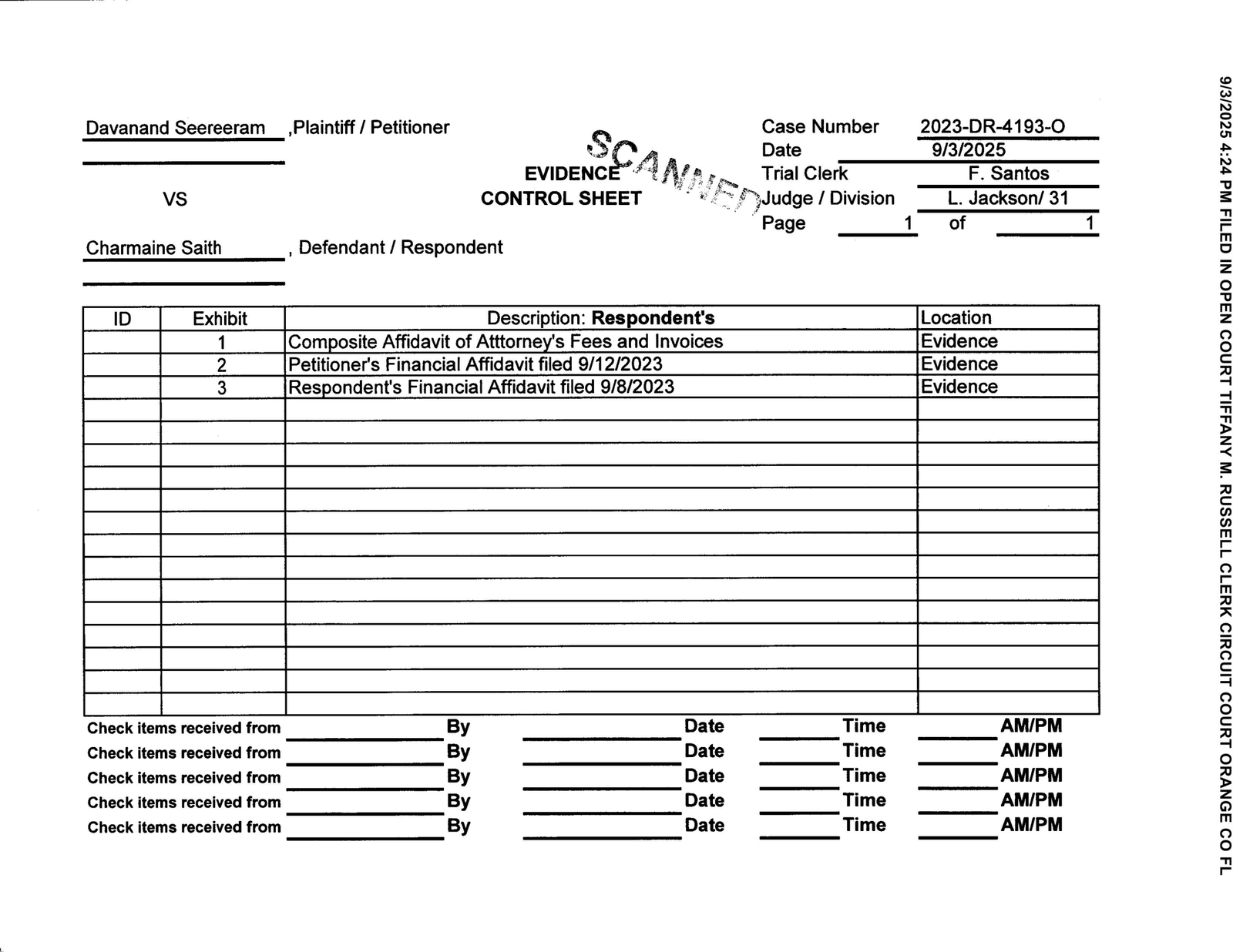
On September 3, 2025, the Wife’s counsel (Mr. Roen) submitted the Wife’s Financial Affidavit filed 9/8/2023 into evidence as Exhibit 3.
The Clerk’s own Evidence Control Sheet records it, below.
At her June 27, 2024 deposition, the Wife testified to assets the 9/8/2023 affidavit does not reflect.
| Asset / account | Amount | Reflected? |
|---|---|---|
| APMEX gold account (precious metals) | $1,411,644.82 | NO |
| Prosperity For Life, LLC investment | $50,500.00 | NO |
| Disclosed at that deposition, absent from the affidavit | $1,462,144.82 |
By relying on the outdated 9/8/2023 affidavit, counsel presented a picture of the Wife’s finances that omits assets she had already sworn to.
9/8/2023
omits $1,462,144.82
$1,462,144.82
per her own deposition
The document itself — the Clerk’s Evidence Control Sheet
Funding trail — how the gold account was funded
The $700,000 and the gold account are the same money, not two separate assets. The total omitted is therefore $1,462,144.82 — the gold balance plus the separate LLC investment.
Dep. 6/27/2024, pp. 15–16
Dep. 6/27/2024, p. 48 & p. 49 ll. 12–21
Dep. 6/27/2024, pp. 66–68
Counsel held the documentation — in her own words
Asked at the same deposition about the $700,000 moved to Fidelity, the Wife testified that the Wife’s counsel already had the paperwork:
What arrived after the sixteen-minute break
The disclosure did not come voluntarily. It came after opposing counsel stopped the deposition to confer privately with his client — and it arrived attached to the accusation that the husband beats his wife. Asked what she was afraid of: “he can be violent.” Asked “Towards you?” — “Yes.” That is an accusation of spousal violence, and it was offered as the reason the $1.4 million had never been disclosed. It is false. Four pages later in the same transcript, the witness gave a different reason — and called it “the real reason.”
Thirty-seven pages earlier, in the same deposition
Before any of this, on page 11 of the same transcript, the same morning, the witness was asked about the first deposition — the one she attended at the husband’s house.
October 15, 2021 — asked by a deputy, on camera, at the time
There is no need to argue about whether the husband was ever violent. Law enforcement asked her directly — in October 2021, the exact period she would later describe as the time she was too afraid to disclose her assets — and it was recorded on three body cameras, synchronised to the same second.
Her friend and realtor of twenty-seven years, present throughout, said the same thing to the deputies — twice:
The deputies reached the same conclusion on the spot — “it sounds like a verbal, she never got hit” · “Never got hit” · “We misunderstood. Sorry… we’re confused.” They told her the remedy for verbal abuse was to go to the courthouse and seek an injunction: “one way you can fix that is to go down to the courthouse and get what’s called an injunction.”
It was never just the gold — and counsel’s answer was “subpoena it yourself”
The two items above are simply what surfaced at one deposition. The 9/8/2023 affidavit entered into evidence in September 2025 also does not reflect the accounts that came to light afterwards.
The position counsel cannot hold both ways
This exhibit is not about the Respondent. It is about the lawyer who had all of this material and chose what to do with it. Mr. Roen has taken two positions in this case, and they cannot both be honest.
Timeline of material events
Every figure above is drawn from the Wife’s own sworn deposition testimony and the Clerk’s Evidence Control Sheet. Prepared: July 24, 2026.